

AI Must Be Used Safely.
- Every unguarded AI deployment in public administration is a compliance risk waiting to materialize.
- Governance is not optional — it is the compliance foundation for every Swiss and European AI deployment.
- vlinq.ai is purpose-built for Swiss and European public sector: sovereign infrastructure, CH-FADP/GDPR-compliant, audit-ready.
Governance Cannot Live in Documentation
Static policies fail in dynamic AI environments. You need active enforcement at every node.
Static Documentation
- Manual compliance checks and annual audits
- Outdated PDFs and spreadsheets
- Reactive incident response after damage is done
vlinq.ai Runtime Enforcement
- Active monitoring and sub-millisecond policy injection
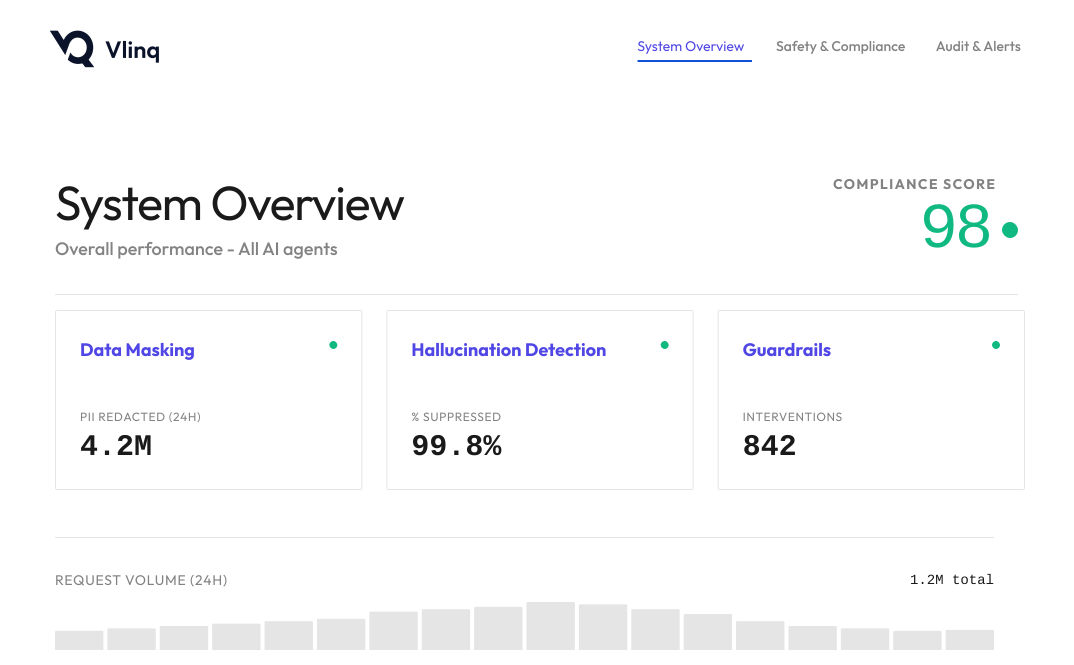
- Real-time hallucination blocks and data redact
- Immutable audit logs for every single AI interaction
The Interceptor Layer: Six Modules
Every governed request passes through this stack — no exceptions
Hallucination Detection
Thought-Observation-Action loops verify every LLM claim against grounded enterprise data before it reaches users. Catches hallucinations at the source — not in the boardroom.
Data Masking
Centralized PII and PHI redaction across every query and response. GDPR compliance enforced at the infrastructure layer — without custom middleware per application.
Guardrails & Policies
Executable rules with human-in-the-loop triggers for high-stakes actions. Policy changes deploy in seconds across the entire AI estate without touching application code.
Misuse Prevention
Detects prompt injection, jailbreak attempts, and policy-violating requests in real time. Behavioral pattern analysis flags misuse before it reaches the model — keeping your AI deployment resilient against adversarial actors and accidental boundary violations.
Skill / Tool Registry
Manages the full lifecycle of AI tools and skills: discovery, authorization, version control, and deprecation. Native support for MCP and Agent-to-Agent (A2A) protocols.
Neuro-Symbolic Engine
Abductive Logic Programming tests proposed actions against rival hypotheses. Shifts AI decisions from lexical correctness to causal soundness — verifiable and explainable.
Zero Trust Features
Every layer of the agentic stack is locked down — from credentials to human oversight.
Dynamic Credential Vaulting
Unique credentials for every user, agent, and sub-agent (NHIs) stored securely in a dynamic vault — no static API keys embedded in code.
Just-in-Time Privileges
Access rights granted only when needed and revoked immediately after, preserving least-privilege alongside RBAC and strong authentication.
Verified Tool Registry
A curated registry of vetted APIs, data sources, and tools ensures the AI agent only operates with trusted, secure ingredients.
AI Firewall / Gateway
An overarching inspection layer monitors all inputs and outputs, blocking prompt injections, data leaks, and improper system calls in real time.
Immutable Logging
Tamper-proof logs that attackers cannot alter or delete, providing full traceability of every agent action and decision.
Pervasive Scanning
Continuous scanning across network, endpoints, and AI models themselves to surface latent vulnerabilities before they can be exploited.
Human-in-the-Loop Guardrails
Kill switches to stop runaway agents, activity throttles to cap harmful actions, and canary deployments to validate behavior before full rollout.
Neuro-Symbolic Integration
We combine the reasoning power of Large Language Models (LLMs) with the absolute precision of Knowledge Graphs. Our engine injects symbolic logic into neural workflows to guarantee compliant outcomes.
Includes best practices for Safe and Responsible AI
Built for Public Administration
Purpose-built for the governance, accountability, and compliance requirements of public institutions — in Switzerland and across the EU.
Swiss Public Administration
For cantons, municipalities, federal departments, and public institutions seeking sovereign AI governance aligned with Swiss law and data residency requirements.
- Sovereign deployment — data processed and stored in Switzerland
- Aligned with Swiss data protection law (revDSG)
- Explainable AI decisions with full audit trails
EU Public Administration
For EU public bodies navigating the AI Act and GDPR. Built for transparency, accountability, and compliance-ready AI governance across EU member states.
- EU AI Act compliance-ready governance layer
- GDPR-aligned data processing and residency
- Auditable AI decision records for regulatory reporting
Ready to get started?
Reach out to discuss how vlinq.ai can be tailored to your institution's specific requirements.
Request a DemoSingle-Box Docker
Deploy in minutes on your infrastructure. Zero-dependency runtime.
Swiss-Made Security
Engineered with Swiss precision and privacy-first principles.
Cloud-Agnostic
No lock-in. Works across AWS, Azure, GCP, or on-premise air-gapped systems.
Open Source at Heart
We believe the best software is built in the open. Open source is not a strategy — it is how we work.
Built on Open Source
vlinq.ai is built on a foundation of world-class open source projects. From our runtime to our security primitives, we rely on the collective intelligence of the open source community to deliver a product that is robust, auditable, and freely inspectable. We are transparent about our dependencies and vet every library we adopt.
- Core runtime built on open source components
- All dependencies publicly disclosed
- Reproducible builds for full supply-chain auditability
Giving Back
We actively contribute upstream to the projects we depend on. Bug fixes, documentation improvements, security patches — if we find something that benefits the community, we send it back. Our engineers are encouraged to participate in open source maintenance as part of their regular work.
- Regular upstream bug fixes and patches
- Security disclosures follow responsible processes
- Engineers contribute on company time
Publishing Our Own Work
Where it makes sense, we release our own tools and libraries as open source. We believe that tooling around AI governance, observability, and safety should be a public good. Releasing our work allows the wider community to audit, extend, and build upon what we create.
- AI governance tooling released publicly
- Community-driven roadmap for open components
- Permissive licences where possible